
Revision intelligence for screenwriters.
Know what to revise next.
You have the script. You have the notes.
Siftiva turns conflicting script notes into a clear revision plan.
Your screenplay + your existing feedback. Not another coverage report.
You got the feedback. Now comes the hard part.
- One reader says the character needs more explanation. Another says you're over-explaining.
- A reader says something is missing. You're certain it's already on the page.
And after 40 notes, you still have one question:
What should I actually revise?
More feedback doesn’t necessarily answer that question.
Siftiva is built for the decision that comes after the notes.
Not more feedback. Revision intelligence.
Siftiva doesn’t add another opinion to the pile.
It analyzes the feedback you already received alongside the screenplay it refers to.
It looks for relationships across reader notes that are difficult to see when you’re comparing reports manually: recurring underlying problems, genuine disagreements, factual claims that can be checked against the script, and issues that deserve attention first.
The result isn’t another coverage report.
It’s a Revision Map.
From reader notes to revision decisions.
Upload your screenplay and feedback from multiple readers. Siftiva finds where the notes converge, where they conflict, and what the script itself supports.
- 01
Upload your screenplay
Give Siftiva the draft your readers reviewed, as a PDF.
- 02
Add your reader feedback
Upload feedback from 2–5 readers for that same draft, as PDF, DOCX, or TXT. Different readers can use completely different language. That's the point.
- 03
Siftiva analyzes the notes together
Siftiva compares the feedback across readers and checks relevant claims against the screenplay. Full analyses typically take several minutes.
- 04
Get your Revision Map
Instead of working through every note independently, see the patterns, tensions, evidence and revision priorities in one place.
Same Root Cause
Different notes can point to the same problem.
Siftiva clusters notes conservatively when there is enough evidence that they’re describing the same underlying issue.
So instead of treating every comment as a separate rewrite task, you can investigate the problem underneath them.
Multiple notes. One problem worth investigating.
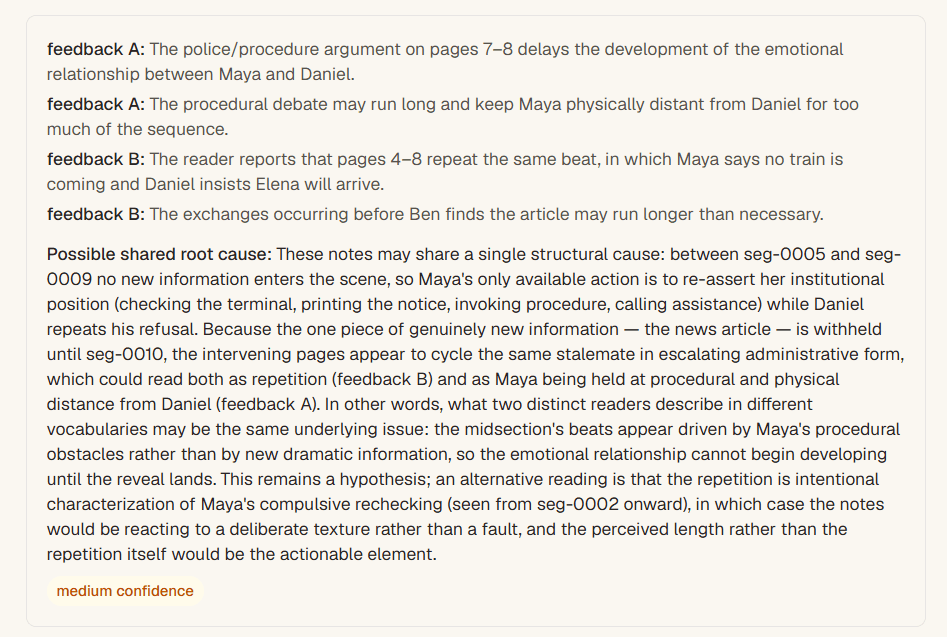
Real output from a sample project: two readers, four notes worded completely differently, clustered under one hypothesis Siftiva rates “medium confidence” — never higher, on a hypothesis, than the evidence supports.
Direct Contradictions
Sometimes the notes really do conflict.
Trying to satisfy both recommendations blindly doesn’t solve anything.
Siftiva surfaces genuine tensions between reader recommendations so you can see where the feedback requires an editorial decision rather than simple compliance.
It doesn’t pretend subjective taste has an objectively correct answer.
It shows you where you need to make the call.
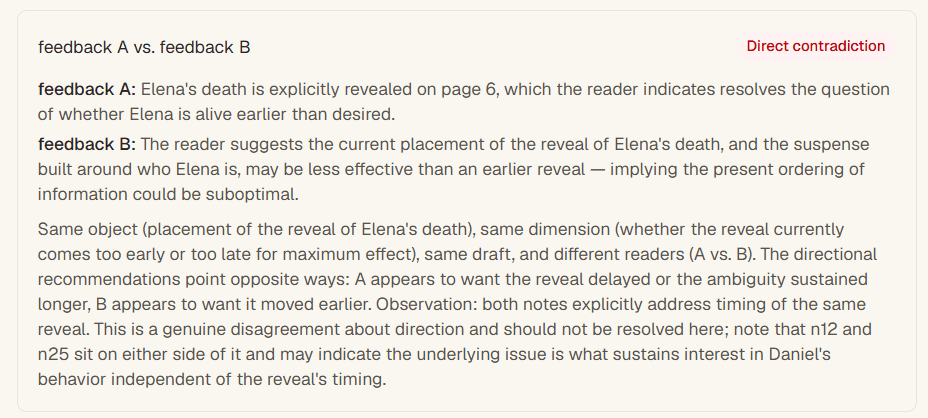
Same object (the timing of one reveal), same draft, opposite directions: one reader wants it held later, the other wants it moved earlier. Siftiva doesn’t average the two into “keep it roughly where it is” — it names the tension and leaves the direction to the writer.
Evidence Check
Is the reader wrong, or is the script unclear?
A reader says information is missing.
You remember writing it.
That’s not always enough to dismiss the note.
Siftiva checks factual claims in the feedback against the screenplay and distinguishes the factual basis of a note from the reader’s interpretation.
It gives you better evidence for deciding what to do with the note.
Reader claim
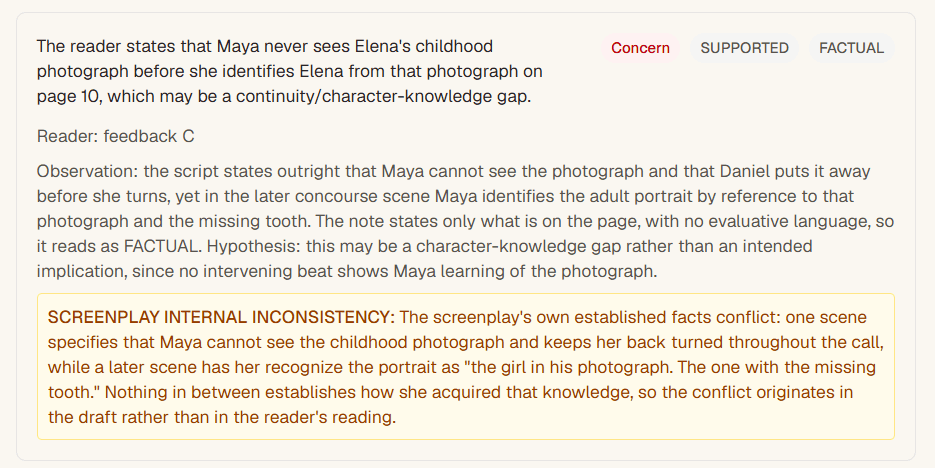
“Maya never sees Elena’s childhood photograph before she identifies Elena from it on page 10.”
Checked against the script
One scene states Maya cannot see the photograph and keeps her back turned; a later scene has her identify the portrait by a detail (the missing tooth) with nothing in between establishing how she learned it.
The conflict is in the draft itself, not in how the reader read it — so this is a script fix, not a note to weigh against taste.
See the real evidence-check card
Other possible outcomes
Revision Priorities
Forty-two notes shouldn’t become forty-two rewrite tasks.
- Some notes repeat the same underlying issue.
- Some are isolated suggestions.
- Some conflict.
Siftiva identifies the issues that deserve investigation first based on the combined feedback and screenplay evidence.
Not a command to rewrite your screenplay a certain way.
A clearer place to start.
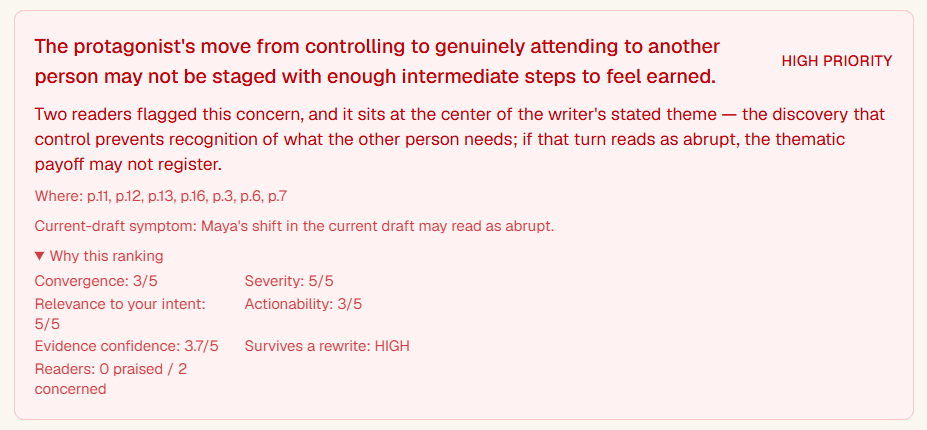
1. The protagonist's move from controlling to genuinely attending to another person may not be staged with enough intermediate steps to feel earned.
High PriorityTwo readers flagged this concern, and it sits at the center of the writer's stated theme — the discovery that control prevents recognition of what the other person needs. If that turn reads as abrupt, the thematic payoff may not register.
Where: p.3, p.6, p.7, p.11, p.12, p.13, p.16
2. The point at which the story's key recontextualizing information arrives may not be positioned to maximize its dramatic effect.
High Priority3. The recurring object or behavior used to externalize the protagonist's need for control may not be established and resolved with enough clarity to carry that function.
High Priority4. The rules constraining the setting — who can be there and for how long — may not be established clearly enough to generate reliable pressure.
High Priority5. Sequences dramatizing the protagonist's process may repeat their information without escalating, costing momentum.
Investigate
Your feedback, mapped into a revision plan.
Every Siftiva analysis produces a Revision Map designed to help you move from reading feedback to making revision decisions.
Same Root Cause
See when differently worded notes may point to one underlying problem.
Direct Contradictions
Find recommendations that genuinely pull the screenplay in opposing directions.
Evidence Checks
Check factual feedback claims against what's actually on the page.
Revision Priorities
See which issues deserve investigation first.
The goal isn’t to replace your judgment.
It’s to give your judgment better information.
Your readers give you perspectives. Siftiva helps you compare them.
Traditional coverage
“What does this reader think about my screenplay?”
In: your screenplay. Out: one more opinion.
Siftiva
“Now that I have all this feedback, what should I actually do with it?”
In: your screenplay + the feedback you already have. Out: a prioritized Revision Map.
Siftiva works with the feedback you’ve already received rather than generating another independent opinion.
Feedback is the input.
A revision decision is the goal.
The goal isn’t to make every reader happy.
A screenplay can become worse by following every note literally — a recommendation may solve one reader’s concern while weakening something central to what you’re trying to write.
Siftiva is designed to organize and interrogate feedback, not blindly enforce it.
You remain the writer. You decide what changes.
Built for writers with real feedback to make sense of.
Siftiva is especially useful when you’ve received feedback from multiple sources and are preparing for another draft.
Where your feedback can come from
If you have one screenplay, several sets of notes and no obvious revision path, you’re at the moment Siftiva was designed for.
FAQ
Questions writers ask before their first analysis.
Does Siftiva write my screenplay for me?
No. Siftiva is designed to help you understand and prioritize feedback before you revise. The creative decisions and the writing remain yours.
Is Siftiva another screenplay coverage service?
No. Coverage gives you another evaluation of your screenplay. Siftiva analyzes feedback you've already received and compares it with the script.
Does Siftiva decide which reader is right?
No. Some claims can be checked factually against the screenplay, but many screenplay notes involve interpretation and taste. Siftiva surfaces the evidence and disagreements rather than pretending subjective decisions have one objectively correct answer.
What is a Revision Map?
The Revision Map is the main output of a Siftiva analysis. It organizes your feedback into shared root causes, contradictions, evidence checks and revision priorities so you can decide what to investigate first.
Should all feedback refer to the same draft?
Yes. For a single Revision Map, the screenplay and reader feedback should refer to the same version of the script.
Can Siftiva tell me whether my screenplay is good?
That's not the goal. Siftiva helps you understand the feedback surrounding your screenplay and make better-informed revision decisions.
Will Siftiva tell me exactly how to rewrite each scene?
No. A Revision Map identifies what deserves investigation and why. It doesn't remove the writer from the revision process.
What file formats and how many feedback sources do you need?
Your screenplay as a PDF, plus 2–5 feedback files as PDF, DOCX, or TXT — one file per reader.
How long does an analysis take?
Full analyses typically take several minutes — Siftiva reads every note against the full script.
What does Siftiva cost?
Siftiva doesn't have published pricing yet.
Is what I upload kept confidential?
See how your files are handled — it describes current, real behavior rather than a general promise.
You already have the notes.
Now know what to revise next.
Turn conflicting script notes into a clear revision plan.
Takes you to the upload form — your screenplay and feedback stay with your project, nothing is shared until you send it.